News

Here you can find short, accessible summaries of recent works, research projects, talks, and other updates.

MoMPy: a Python package for SDP relaxations

Quantum and classical randomness illustration

Semidefinite block-matrix relaxations

Photon communication and randomness illustration

Bound entanglement can boost communication

Bound entanglement illustration

When entanglement only helps when its noisy

Entanglement and noisy communication illustration

Quantum vs. classical randomness

Quantum and classical randomness illustration

Communication and randomness with photons

Photon communication and randomness illustration

MoMPy: a Python package for SDP relaxations

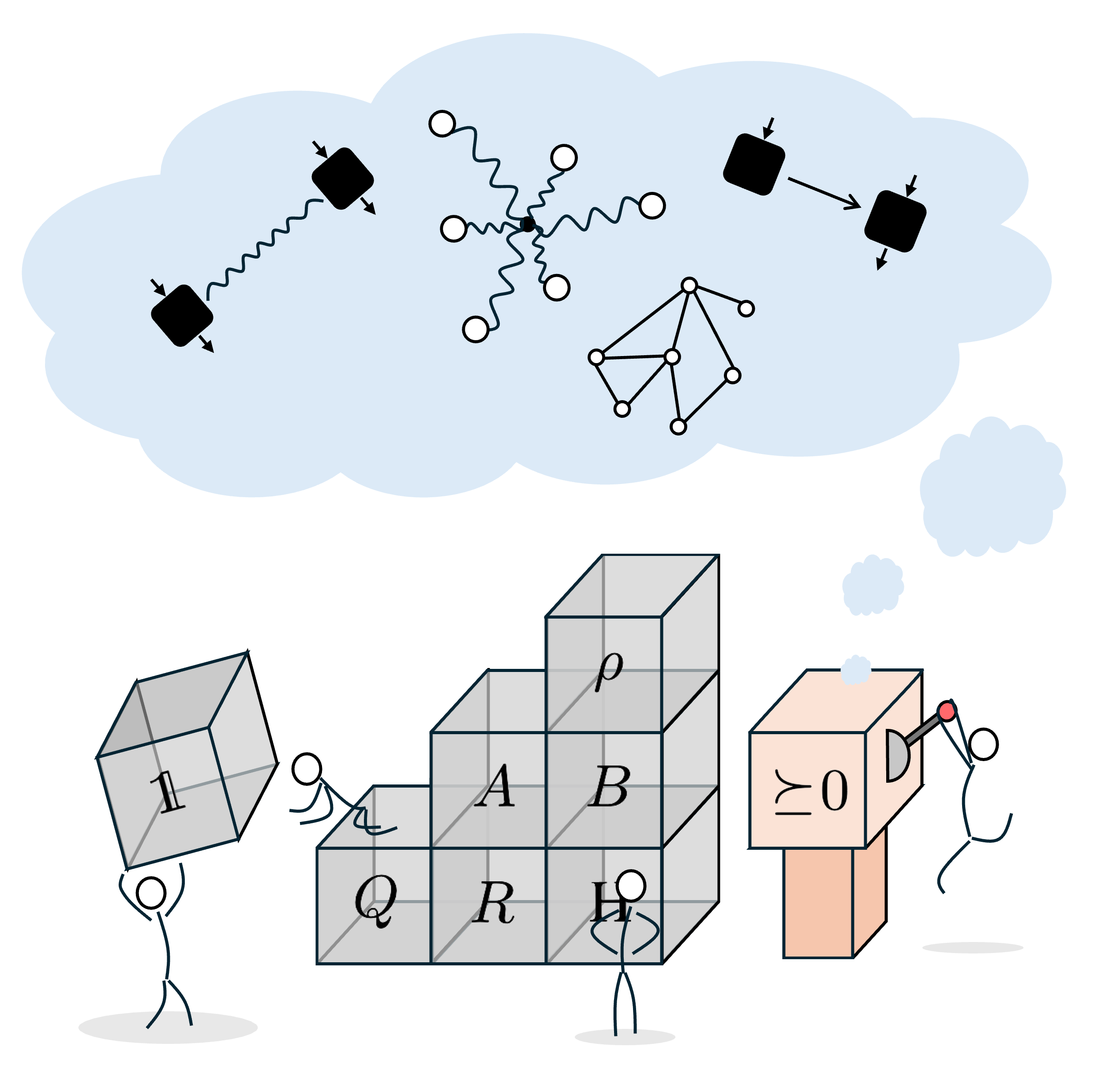
Moment matrices are a powerful way of turning difficult questions in quantum information into tractable optimisation problems, but building them correctly can be surprisingly complicated: many entries are actually the same because the underlying quantum operators obey mathematical relations such as commutation, orthogonality, and idempotency.

MoMPy is an open-source Python package that automates this bookkeeping. You declare the operators and their relations, choose the products you want to include, and MoMPy constructs the corresponding moment matrix, automatically identifying equivalent terms and producing the variables needed for a semidefinite-programming relaxation. Read here a tutorial introducing the package. You can find all codes here.

Illustrative image for work three

Semidefinite block-matrix relaxations

Illustrative image for work four

Quantum experiments are often difficult to analyse because we want to optimise several things at once—such as quantum states, measurements, and their physical constraints. Semidefinite programming can turn these problems into tractable mathematical ones, but existing methods struggle when realistic constraints such as imperfect measurements, limited dimensions, or calibration errors are involved.

Here we introduce a general semidefinite-programming framework based on block moment matrices that can incorporate a much broader range of physical constraints, extending the influential Navascués–Pironio–Acín (NPA) approach. We demonstrate the method on five problems: making entanglement witnesses robust to imperfect measurements, certifying measurements from imperfect sources, detecting high-dimensional multipartite entanglement, determining the dimension required by quantum state-preparation devices, and deriving uncertainty relations for imperfectly calibrated observables.

Bound entanglement can boost communication

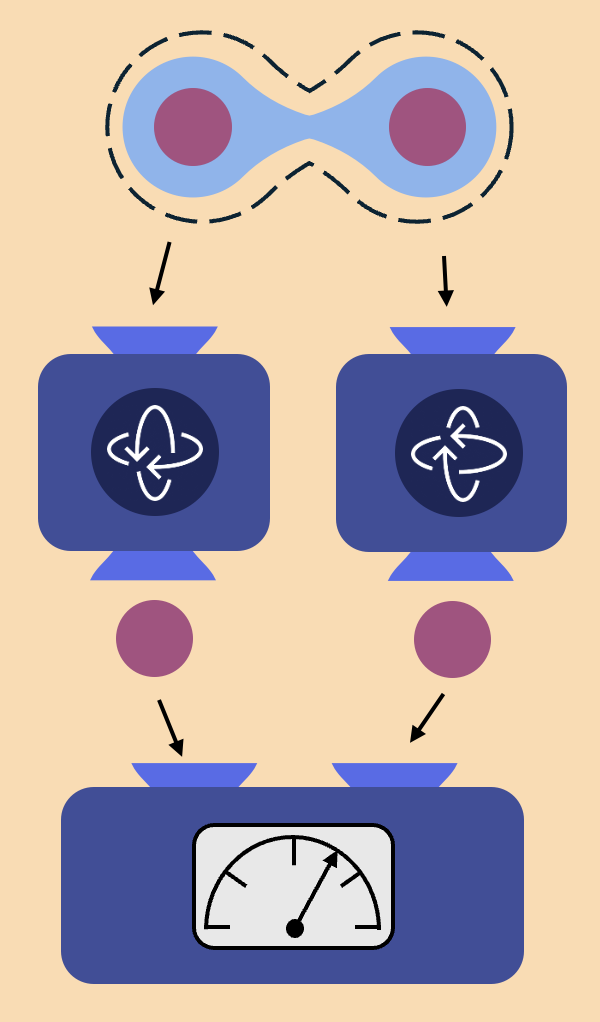
When two objects interact, some of their physical properties can become correlated, establishing an invisible connection between them. If one of these properties is measured in one object, the corresponding property in the other becomes instantaneously affected, even if they are at opposite ends of the universe. This mysterious connection, commonly known as entanglement, is a fascinating phenomenon discovered over a century ago and still defying our notions of reality. Entanglement is also an extremely useful resource in quantum information, and can appear in various forms. Certain states (known as “bound entangled states”) exhibit a form of entanglement which is restricted, i.e., cannot be strengthened operating individually in both objects. Bound entangled states have for long been deemed useless in communication tasks. Here we show that this is no longer true, proving a significant communication advantage when bound entangled states are employed.

Read more here about how bound entanglement can be useful to boost communication, and here about how this usefulness can become an unbounded advantage.

Illustrative image for work one

When entanglement only helps when its noisy

Illustrative image for work two

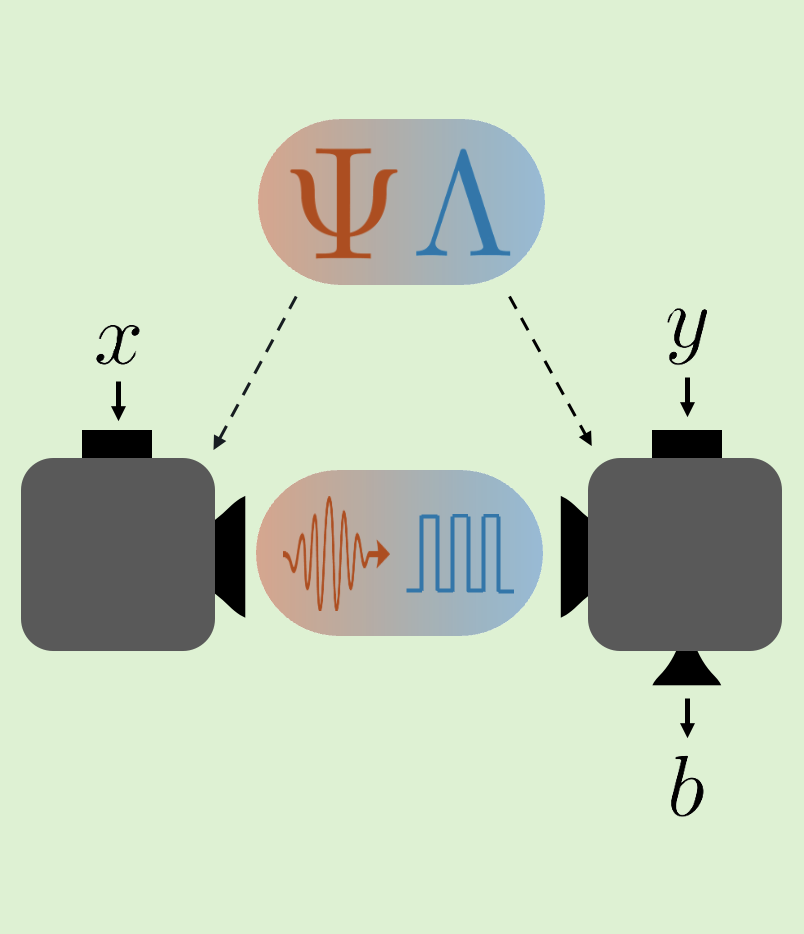
It is well known that communication capacity can many times be improved if both sender and receiver are allowed to share quantum entanglement. It is, however, yet unknown if entanglement enables similar communication advantages in scenarios only restricted by a natural constraint such as the energy.

In this work we address this gap, revealing three surprising results. First, we derive a performance bound satisfied by communication scenarios assisted by non-signalling correlations and show that it can be saturated with standard communication tasks, deeming the entanglement resourceless. Second, we prove that entanglement also fails to be a resource in quantum communication based on traditional unitary encodings. It is only when the sender purposefully decoheres the entanglement that communication advantages are unlocked. And third, we deploy our findings to estimate how entanglement-based hacking attacks affect quantum random number generation which, so far, has only been secured assuming classical side information. Although certified randomness becomes notably reduced in the high energy regime, the effect becomes negligible in the practically relevant low-energy regime.

Quantum vs. classical randomness

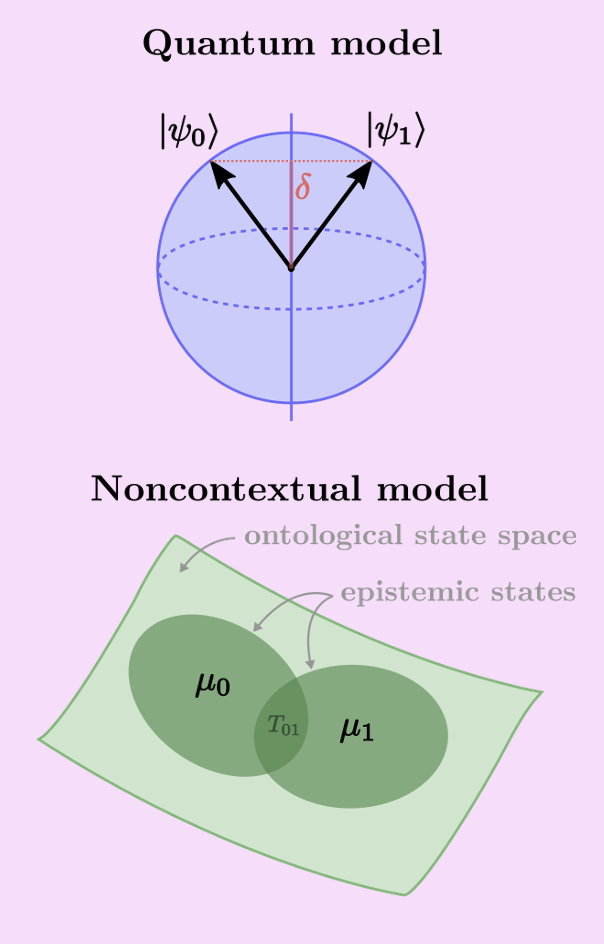
Random numbers are essential for modern security, but trusting a random-number generator is harder than it sounds: how do we know its outputs are genuinely unpredictable, rather than secretly known to an hypothetical adversary? One powerful answer comes from quantum physics, where measurement outcomes can be certified as random even when the devices’ inner workings are only partly known.

Here we ask whether quantum devices can certify more randomness than any comparable “classical” device. Here, classical does not simply mean old-fashioned; it means noncontextual, when measurement outcomes may be explainable by revealing pre-existing values. The comparison is more subtle than a simple “quantum always wins”. If the hypothetical adversary is restricted to the same noncontextual classical rules, then classical-looking models can sometimes certify as much, or even more, randomness . But when the adversary is allowed the full power of quantum physics, quantum devices recover the advantage, although noncontextual statistics can still generate genuine randomness.

Illustrative image for work three

Communication and randomness with photons

Illustrative image for work four

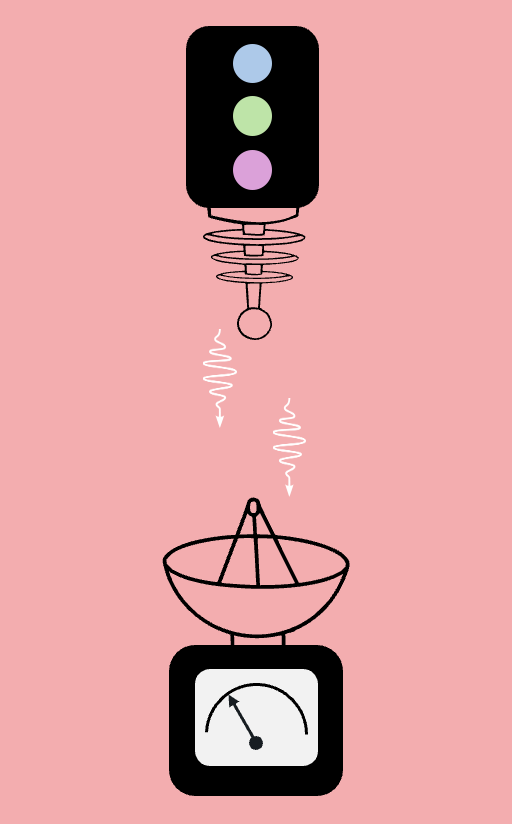
A fundamental challenge in quantum communication is characterizing the behavior of quantum devices under various physical limitations. While dimension-based assumptions have been widely studied, they suffer from serious practical limitations. This work replaces these abstract assumptions with photon-number constraints: a natural, measurable feature of light. We introduce a general framework for characterizing optical quantum devices under such constraints, making certification more realistic and broadly applicable.

By improving state-of-the-art randomness generation and proposing new communication protocols, this work brings quantum theory closer to practical technologies and opens new directions for secure quantum communication.